


Advancing Reliability Across Mission-Critical Test Programs
Validate critical hardware for aerospace and defense applications prior to system integration, flight testing, or field deployment. DMC develops custom-designed Hardware-in-the-Loop test solutions that leverage deterministic real-time simulation, avionics and power bus emulation, fault injection, automatic test sequencing, and synchronized data acquisition.
DMC HIL solutions allow engineering teams to safely exercise boundary conditions, validate controller functions, lower dependency on limited prototype resources, and generate reproducible test results at an earlier point in the product development life cycle.
Whatever the need, avionics Line-Replaceable Units (LRU) or power electronics, propulsion, actuation, or embedded control systems, DMC builds open and sustainable HIL test systems based on your application requirements.


Reduce Risk Before Integration, Flight Test, and Deployment
HIL simulation provides a safer, quicker means for aerospace and defense organizations to qualify real hardware under realistic system conditions without having to integrate or deploy in the field. By interfacing control systems, avionics, power electronics, actuators, or embedded software to the real-time simulation environment, one is able to perform testing of nominal operations, boundary conditions, and failure modes in a safe laboratory environment.
This method reduces reliance on prototypes that are scarce, lowers hardware risk, and increases assurance before moving into more expensive testing stages. DMC can provide HIL systems to help businesses move faster through design cycles, automate the validation process, collect synchronized test data, and verify performance metrics.
Real-Time, Avionics, Power, and Fault-Insertion Capabilities
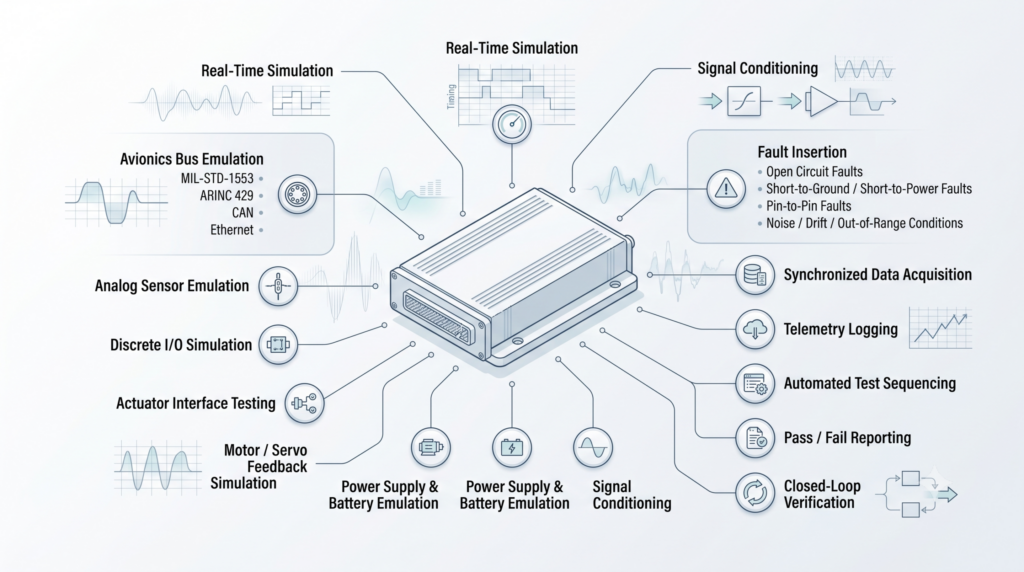
DMC’s HIL testing solutions are created with an understanding of the electrical, timing, and interface requirements of aerospace and defense components. This technology incorporates real-time simulation, high-mix signal processing, avionics bus simulation, power interface hardware, fault-insertion automation, and synchronized data capture to test for critical behaviors in realistic environments.
From avionics line-replaceable units and embedded controllers to actuator subsystems, power electronics module, or integrated subsystem bench, DMC engineers the hardware and software frameworks for stimulation, monitoring, fault insertion, and validation of interfaces.
- Analog sensor emulation
- Discrete I/O simulation
- Thermocouple, RTD, LVDT, resolver, and encoder emulation
- PWM generation & measurement
- Custom load emulation
- Power supply and battery emulation
- Bus communication monitoring and emulation
- Message dropout and timing faults
- Fault insertion testing
- Actuator command/response validation
Strategic Partnerships
DMC combines proven instrumentation, modular I/O, high-density switching, and mass interconnect solutions through collaborations with NI, Beckhoff, UEI, Pickering Interfaces, and MAC Panel for the delivery of scalable HIL solutions customized to the needs of individual aerospace and defense programs.


Custom HIL Architectures Built Around Your Aerospace & Defense Program
From real-time simulation through instrumentation, signal processing, power interfaces, fault injection, data acquisition, software automation, operator interfaces, and sustainment, our engineers cover all aspects.
This means that we deliver you a tailor-made HIL solution suited not just for your production line, but for your signals, models, test process, cybersecurity needs, documentation, and sustainment requirements.
DMC is platform-agnostic. As a trusted systems integrator, we help aerospace and defense teams select, integrate, and sustain the HIL architectures & platforms best suited to their program.

Focused on the Priorities That Drive HIL Test Program Success
Test programs within aerospace and defense need more than reliable hardware. They need reliable results, realism, traceable evidence, and systems that can evolve.
- Open, Scalable Systems for Sustainment
Start with the capability your program needs today, then expand through open, modular architectures that reduce vendor lock-in, simplify modernization, and support long-term ownership. - Realistic Aerospace Interfaces
Direct interfacing to the buses, signals, loads, and faults employed by your hardware allows for more realistic testing before the systems are integrated, flight-tested, or deployed. - Traceable, Defensible Test Evidence
Generate test data that helps your team validate designs, debug problems, gain customer acceptance, satisfy certification requirements, and maintain programs.

Integrated Engineering and Manufacturing for HIL Systems
DMC’s Chicago Manufacturing Center offers a structured internal progression for HIL rack development from control panel manufacturing to assembly, integration, wiring, and system testing.
This streamlined approach eliminates the risks associated with passing the product to another person and helps to make sure that the system will be fully operational at delivery.
- 25,000 sq. ft. industrial manufacturing facility
- Dedicated mechanical and electrical design teams
- UL508A certified panel shop for deployment-ready panels
- Build-to-print or design-to-build engagements
- ISO 9001 certified quality management system

Our Aerospace & Defense Customers
Counted on by the industry’s most recognized aerospace and defense companies to provide engineered testing capabilities that enhance verification, foster program consistency, and enable the development and integration of mission-critical systems.



Aerospace HIL Testing Projects


FAQs
What is Hardware-in-the-Loop testing?
Hardware-in-the-Loop testing places real hardware in a closed-loop environment with a real-time simulation of the surrounding system. It is used to validate behavior safely, repeatedly, and automatically, including scenarios that would be impractical or dangerous to reproduce on a full physical system.
Why is HIL especially valuable in aerospace and defense?
Aerospace systems are mission-critical, interface-dense, and often costly to test only on integrated hardware. HIL lets teams verify avionics, power electronics, control logic, and fault handling earlier, which reduces risk before full system integration, qualification, or operational testing.
What aerospace interfaces can a HIL system emulate or monitor?
A practical aerospace HIL bench may need to support generic avionics and control interfaces such as MIL-STD-1553, ARINC 429, ARINC 664, RS-232/422/485, CAN, Ethernet, and custom or modified protocols. The exact interface set depends on the unit under test, latency requirements, and whether the bench must monitor, emulate, fault, or do all three.
Can a HIL system perform fault insertion safely?
Yes. Fault insertion is one of the core reasons teams invest in HIL because it allows them to test open, short, reversal, bus interruption, and other abnormal conditions without exposing full prototype or flight hardware to the same level of risk. On well-designed benches, fault insertion is software-commanded, repeatable, and traceable.
How deterministic does a HIL system need to be?
That depends on the subsystem, but aerospace buyers should evaluate latency, determinism, redundancy, and fault tolerance up front. When the application involves fast control loops, synchronized acquisition, or protocol-aware timing, real-time targets and, when needed, FPGA-backed execution become important design choices.
Should we build a new HIL rig or modernize an existing one?
If the existing mechanical and electrical assets are still strong, modernization is often the faster and lower-risk option. A phased refresh of controls, software, instrumentation, logging, and user interfaces can improve cybersecurity, diagnostics, traceability, and maintainability without forcing a full rip-and-replace project.
What usually drives cost and schedule on a custom HIL project?
The biggest drivers are I/O count and diversity, protocol complexity, custom interface hardware, fidelity requirements, fault insertion scope, software integration needs, documentation depth, and acceptance/commissioning requirements. Modular architectures and shared test equipment can reduce both non-recurring engineering and future expansion cost.
